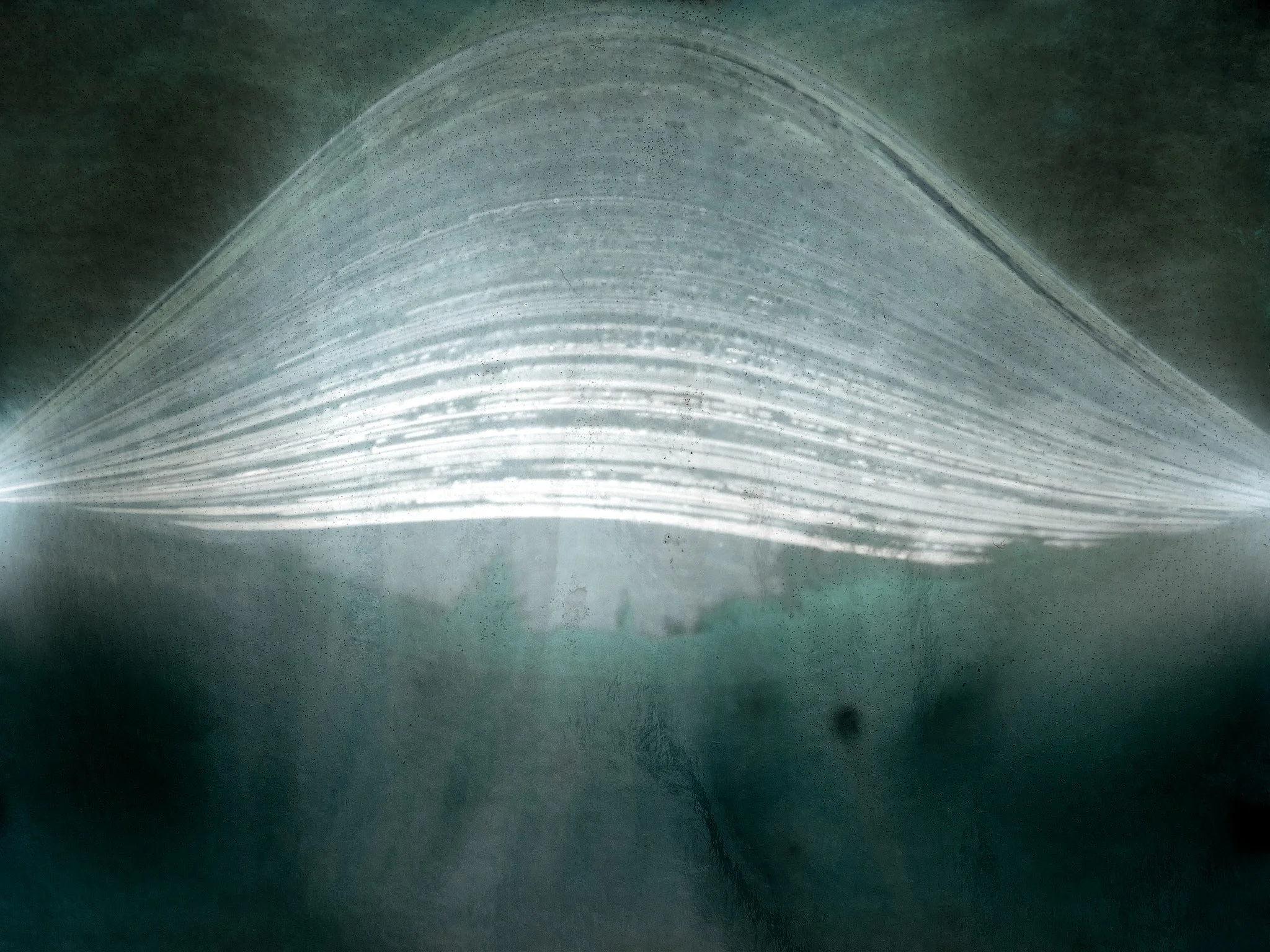
Vizovice 444/I.
From time to time, I find myself drawn to various photographic exercises to enhance my skills, create something unexpected, or simply try something new. As my photographic practice, particularly my work with night landscapes, involves a great deal of long exposures, I decided to take on what seemed like the ultimate test: recording the passage of time over an extended period. Enter solarigraphy.
Choosing a subject to photograph using the solarigraphic technique was easy. The Sun would always be the focus of the picture. The closest and brightest star from Earth’s point of view appears in the sky every day, even when obscured by clouds suspended in the atmosphere. On clear days, or during periods of partial clarity, the Earth’s rotation creates paths of sunlight across the sky from east to west. This pattern is invisible to the human eye, yet capable of being recorded photographically.
Choosing the viewpoint, however, proved more challenging. The camera itself is remarkably simple: a small tin, resembling a beer can, with a tiny pinhole through which the light enters. It needs to point south for obvious reasons. Inside, a piece of photographic paper records the passage of time, gradually accumulating lines of light, whether the Sun is shining or hidden behind clouds.
For my first experiment, I chose my native town of Vizovice in the Czech Republic. Our family land just outside the town seemed conceptually ideal, but it presented a practical problem. Although it is private property, there was always the possibility that someone might tamper with the camera or even take it away.
In the end, I received help from friend David, who suggested the rooftop of a building he owns in the town centre. There, the “camera” could remain undisturbed, its exposure continuing for an indeterminate period, ultimately terminated by my next return home from London, where I live.
A single cobblestone was used to weigh down and prop up the tin at a particular angle. The camera was secured to the cubic stone with strong tape and left to face the sky. The object with a pinhole was allowed to accumulate light and time to pass.
After 444 days, David collected the rudimentary camera from the roof of the building, which had once been a distillery, and passed it to me. By then, the elements had already left their own marks on the experiment. The exposed part of the tape had been reduced to fragments by sunlight, heat, wind, rain, cold, snow, humidity, and moisture. What remained was the mesh dangling in front of the pinhole.
At that point, I deliberately tried to suppress my excitement. The entire experiment might have come to nothing. The conditions had been extreme. The lowest recorded air temperature in Vizovice during the winter was −17°C, while the highest reached +34°C in summer. On the flat, black rooftop, the actual temperature may have been considerably higher. There were countless ways in which the experiment could have failed. A trickle of water entering through the pinhole could have ruined the photographic paper inside. A bird could have left a dropping over the opening. The camera itself could have been disturbed or damaged.
After opening the tin, made by the Solarcan company, I carefully freed the photographic paper from its holder in the semi-darkness of a bathroom. And there they were. Black lines on the shiny surface of the paper. The light of the Sun had indeed been captured. For 444 days, the movement of the Earth had been quietly writing itself onto this small piece of photographic paper. What I was holding in my palm was not simply an image of the Sun, but a physical record of time and the movement of our planet through space.
The distinctive waves of the Sun’s path (actually, the path created by the Earth’s movement) stretched across the paper. The uppermost line corresponded approximately to the summer solstice, while the lowermost represented the winter solstice in the Northern Hemisphere. Between them, hundreds of days had accumulated as a sequence of light and darkness.
There is something almost paradoxical about the process. At first glance, solarigraphy seems to belong to the earliest days of photography. The principle is remarkably simple: light enters through a tiny aperture and leaves its trace on a photosensitive surface. Yet the resulting image is not merely a representation of a moment. It is the accumulation of time itself.
In order to preserve the image, however, another technological step is necessary. The photographic paper must be scanned and converted into a digital file; otherwise, continued exposure to light will eventually turn the entire surface black. I did not have a scanner at hand, so I photographed the image digitally instead.
The process therefore becomes a meeting point between analogue and digital photography. The resulting negative must be inverted into a positive, and the image flipped because the optical principle of the pinhole projects the scene upside down and in reverse. Basic post-production, such as increasing the contrast, is then necessary, along with a few minor adjustments.
The principles behind the pinhole camera are ancient. Optical observations involving the pinhole are recorded in Chinese texts dating back to the 5th century BC, while the first pinhole photographs were made in the 1850s by the Scottish astronomer and mathematician Sir David Brewster. Solarigraphy itself emerged much more recently, in 2000, through Project Solaris, initiated by Paweł Kula, Sławomir Decyk, and Diego López Calvín.
Millennia had to pass before the fundamental workings of the Universe—the movement of celestial bodies through the flow of time—could be described and eventually recorded on a piece of photographic paper. And yet, despite the procession of time being recorded on black and white photographic paper, the resulting image usually emerges in colour. There may be different colours with every attempt. Humidity, temperature, and chemical changes within the paper during such prolonged exposure influence the way these colours develop and shift. The final image is therefore partly predictable and partly beyond control. The photographer sets the conditions, but then has to surrender the outcome to time and the elements. Perhaps this is what makes solarigraphy so compelling.
For 444 days, the Sun moved across the sky above Vizovice, whether I was there to see it or not. Clouds interrupted its journey. Seasons changed. Temperatures rose and fell. Rain, snow, wind, and dust came and went, so the scaffolding on the local church of St. Laurent. The town continued its ordinary existence beneath it all. The camera recorded none of these things individually. Instead, it quietly accumulated picture of time, light and any stationary objects like buildings or trees.
The resulting photograph is therefore not a picture of a particular day, nor even a picture of the Sun. It is a small physical trace of an immense movement: the Earth turning beneath the Sun, day after day, season after season. What would normally remain imperceptible to us has been compressed into one single surface that is about the same size as palm of the hand.
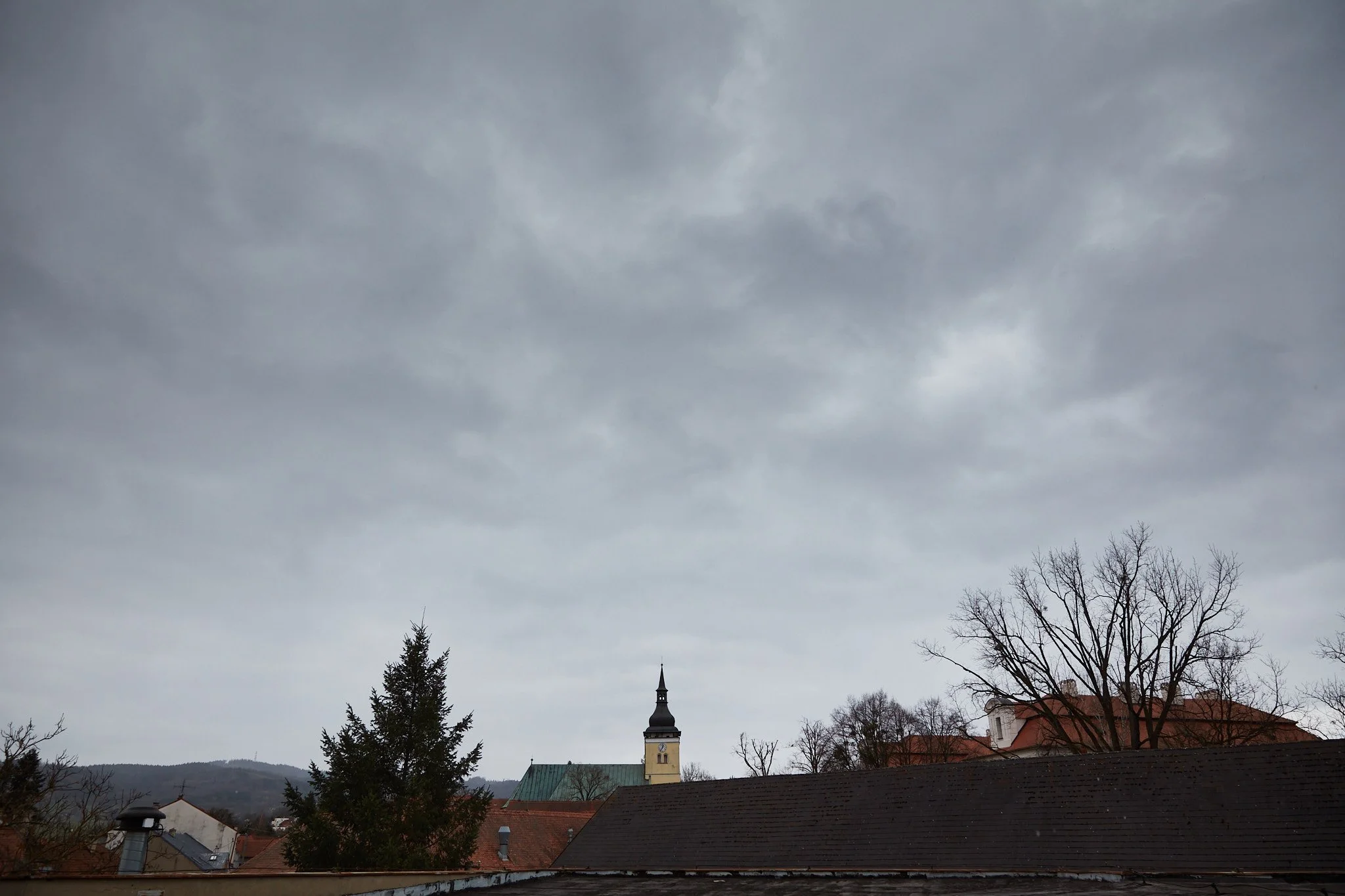
The view of the scene as seen on the first day of when the exposure began (Church of St Laurent, Vizovice, Czech republic)